| 
Posted August 31, 2004: Small-scale Mexican
corn farmers were expected by experts to abandon fields all
over Mexico, due to the near-complete loss of farm subsidies
combined with the opening of the Mexican market to heavily
subsidized US corn. Subsidies for Mexican farmers have dropped,
at the behest of US “free market” proselytizers,
from 33% of farm income to less than 13%, while during the
same period subsidies for US farmers have grown and now make
up 40% of US farm income. Cheap corn from the US is flooding
the Mexican market and competing with the locally grown corn.
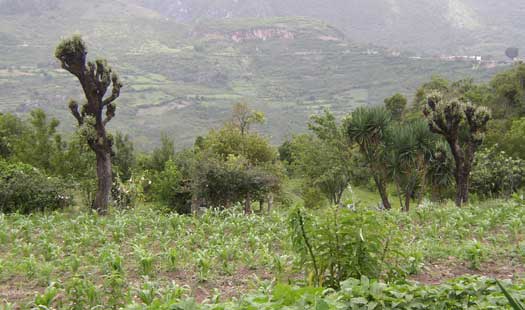
But against all predictions, corn acreage is up in Mexico,
despite the economic disincentives. Different theories are
tossed about as to the reasons. Remittances (money sent from
Mexicans in the US), a $13 billion industry, larger than Mexico’s
agricultural economy, are believed by some to currently subsidize
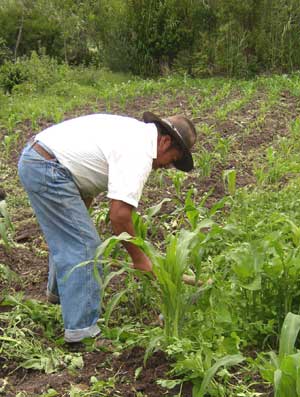
small-scale corn production. Some farmers must keep cultivating
land in order to maintain rights to it, so they plant what
they are accustomed to growing: corn.
These small-scale corn farmers, now almost completely abandoned
by their government, as well as by the market system, are
also the guardians of most of the world’s corn biodiversity
-- the approximately 60 major land races, as Mexico is the
major center of origin and diversity of corn. The fact that
the Mexican government, along with the NAFTA administration,
willfully designed an economic policy to drastically reduce
the number of small farmers who are the keepers and original
developers of such a valuable resource, is unconscionable.
On top of the loss of corn as the economic base of rural
Mexican communities is the problem of contamination of indigenous
corn by transgenes, genes from genetically modified US corn.
Mexico’s shift to the “free market” directly
underpins the contamination of the native varieties corn by
transgenes: Mexico imports about five million tons of corn
a year from the US. On the average, 30% of the US corn is
transgenic, which has been mixed with non-transgenic corn.
While the cultivation of transgenic crops is not yet permitted
in Mexico, their import as food and feed is. It is now believed
that the transgene contamination came from Mexican peasant
farmers buying corn from local stores and, as is common here,
planting it as part of their corn crop.
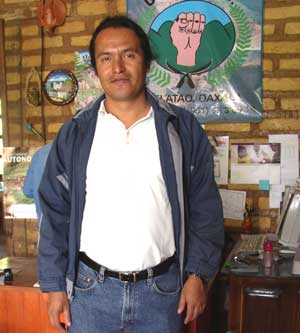
According to Aldo Gonzales of the Uníon de Organizaciones
de la Sierra Juarez Oaxaca, a group dedicated to the welfare
of indigenous farmers, the most likely channel of entry of transgenic
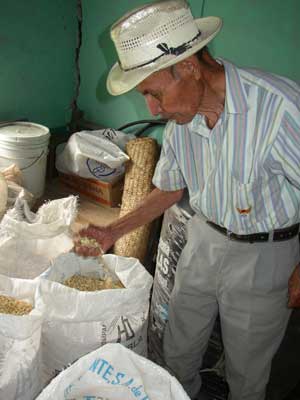
corn was via the local government stores which sell grain in
rural areas all over Mexico. Transgenic corn that was imported
from the US was mixed with corn for sale via the government
stores, named DICONSA. Farmers often plant the seed sold at
DICONSA stores. The distinction between corn as feed or food
and corn as seed for planting has never traditionally existed
in rural Mexico.
Guelatao de Juarez, the town where Gonzales’ group
is based, is one of the communities where transgenes were
found in the corn crops of indigenous farmers. Samples from
the local DICONSA stores were transgene positive as well.
The controversy first broke when Ignacio Chapela and David
Quist of UC Berkeley published a paper in the journal Nature
in December 2001 showing that transgenes from Bt and RoundUp
Ready corn contaminated the local corn in Oaxaca. The evidence
showed that the transgenes had “introgressed”
into the local corn, meaning that, mostly likely via pollen
transfer from transgenic corn plants, the genes had been transferred
to the local corn. The next year, Mexican government scientists
showed the same result, concluding that 3% to 60% of corn
samples were contaminated with transgenes. Furthermore, it
was stated in the Chapela article that the promoter gene,
known as the 35S promoter, originally from cauliflower mosaic
virus, was probably one of the polluting genes. The function
of the promoter gene is to turn on the target transgene. Much
is unknown about what the promoter gene would do in the native
corn plants.
Transgenes in corn are independent entities so that when
they introgress into populations they can be more or less
hidden. In other words, if pollen from transgenic yellow corn
(all commercial transgene corn is yellow) fertilizes white
corn, the kernels that were pollinated will develop into yellow
grains where the transgenic pollen fertilized, but not necessarily
in subsequent generations. Subsequent generations of corn
can be yellow with transgenes, white with transgenes, yellow
without transgenes, or white without transgenes.
Different transgenes can end up mixed in one plant. No testing
has ever been done on such mixes, and no one knows what effect
this kind of mixture may have on human or animal health.
A storm of controversy, created by the biotech industry PR
machine, followed the findings of Quest and Chapela. For the
first time in its 133 year history, Nature, considered the
top science journal in the world, published an “apology”
(short of a retraction) stating that they should not have
published the paper, even though it had been reviewed by scientific
peers. It turns out that they were under intense pressure
from the biotechnology community, reportedly facilitated by
a PR firm hired by Monsanto, to retract the paper.
When scientists from the Mexican government submitted to
the results of their study, which verified the Quist and Chapela
results that there is transgenic contamination in Mexican
corn, the two peer reviewers for Nature turned it
down – one stating that the results were already common
knowledge (!) and the other rejecting it saying that the percentage
contamination was too high to be believable.
The possible reasons behind the Nature editors’
questionable decisions came out via some aggressive investigative
journalism by a writer for The Guardian (UK), George
Monbiot, who uncovered a surreptitious, neo-viral type PR
campaign whose goal was to attack and undermine the
work of Chapela and the Mexican scientists. The PR firm, the
Bivings Group, was reported by Monbiot to be a client of Monsanto
and other biotech firms. The attacks were carried out, using
the names of individuals who were supposedly scientists, via
postings on the main pro-biotech Internet discussion group,
AgBioWorld.
The Guardian quoted the following from the Bivings
Group’s website about their “viral marketing”
strategy:
“There are some campaigns where it would be undesirable
or even disastrous to let the audience know that your organization
is directly involved ... it is possible to make postings to
these outlets that present your position as an uninvolved
third party ... Perhaps the greatest advantage of viral marketing
is that your message is placed into a context where it is
more likely to be considered seriously.”
Incredible is the fact that, despite world concern and huge
gaps in knowledge, no new analyses have been done for the
2003 Mexican corn crop, or at least, no results have been
released. Just at the time that the whole issue needs clarifying,
there is no information whatsoever. I received the following
response from the David Poland of the International Center
for the Improvement of Maize and Wheat (CIMMYT), near Mexico
City, the world center for the monitoring of corn genetics,
when I asked about follow-up analyses of Mexican corn:
“I don’t know of any analysis of field samples
done by CIMMYT for 2003… Nobody has stepped forward
with funds to conduct such studies. Our core budget is under
extreme pressure from ….cutbacks….We have sought,
without success, to get the (latest analysis) data from INE/CONABIO
(the Mexican government), including methodology, but they
will not release it nor publish it in a peer reviewed journal.”
There may be legitimate questions about the methodology
and accuracy of the analyses that have been done for transgenes.
At least one corn geneticist maintains that transgene contamination
levels of over a few tenths of a percent would indicate faulty
methodology. False positives can also be a problem, especially
when the levels of the target compounds are low, such as 1%
to 3%.
If this is the case, then why have there not been any new
analyses which attempt to remedy these methodological problems
and clarify the situation?
The whole thing smacks of cover-up, not necessarily by CIMMYT,
but by the entities involved in funding further studies, making
policy, and developing transgene products.
Strengthening the case for cover-up is the recent decision
by the North American Commission for Environmental Cooperation
(CEC), under pressure from the US to delay the release of
a report on transgene contamination of Mexican corn, which
had been scheduled to be released June 7. The report ostensibly
contains the most recent analyses of Mexican corn for transgenes.
The CEC, a Montreal-based body set up as part of the environmental
aspects of NAFTA, is currently the main international organization
that appears to be “in charge” of monitoring and
recommending policy on the issue of trans-border transgene
contamination in North America, as the contamination came
about as a result of trade.
The CEC report comes as part of a legal process initiated
by non-governmental organizations in Mexico, led by Greenpeace
Mexico, filed under Article 13 of the North American Agreement
on Environmental Cooperation, which challenges the legitimacy
and safety of US corn exports to Mexico.
As part of this process, the CEC created the Maize and Biodiversity
Advisory Group and in March 2004 hosted a conference in Oaxaca
“Maize and Biodiversity: The Effects of Transgenic Maize
in Mexico”. Some of the world’s top corn scientists
presented papers on the issue. The conclusions were not earthshaking,
but they were significant:
- The fact that transgenes have indeed polluted Mexican
indigenous corn crops is irrefutable. This backs up the
Chapela study and throws the entire incident of its retroactive
disavowal by Nature, and the attacks by the biotech
community, into sharp relief: it was and continues to be
politically-based manipulation of science and the suppression
of scientific evidence.
- The dynamics of gene flow in corn are extraordinarily
complex and scientists know little about how the genetics
of transgenes will develop in the Mexican corn populations.
Nor does anyone know what the ecological and human health
effects will be.
- Transgene contamination is currently continuing and will
spread, if no action is taken.
The final report and recommendations of the Advisory Group
were to have been released this month (June 2004) at a conference
in Puebla, Mexico. However, the commission, made up of representatives
from the US, Canada, and Mexico, has postponed the release
of the report. According to a June 22 article in the Mexican
newspaper La Jornada, the commission is under pressure from
the US and multinational biotech companies to delay the report,
whose release would support the case of an EU ban on transgenic
crops from the US. The US is currently challenging, via the
WTO, the EU ban.
The pressure from the US to delay the release of the Maize
and Biodiversity Advisory Group’s report comes despite
the fact that the group is heavily skewed toward the biotech
industry, despite Article 13’s proviso that advisory
groups be made up of “independent experts”. At
least five of its 16 members are directly involved in or benefit
economically from the biotech industry. The original group
had no one whatsoever from groups representing indigenous
farmers or environmental groups, nor did it have any scientists
specializing in corn. After pressure from the original groups
who brought on the investigation, one woman from a Oaxaca
farmers group was admitted.
Mexico is under intense pressure from the US to back the
US’s pro-transgenic crops policies. Many groups here
in Mexico are accusing the Mexican government of caving in
to pressure from the US and multinationals in not moving swiftly
to develop a strong policy against transgenics. The incipient
weak Mexican government policy on transgenics is consistent
with its policy toward small farmers, that of catering more
to the interests of large-scale agriculture and industry.
Similar scenarios are being played out in other countries
like India and Thailand.
The next year or two will continue to be watershed years
in the history of the genetic makeup of the human food system,
and the story unfolding in Mexico may play a critical role
in determining which direction the issue flows.
COMING NEXT: An overview of
organics in Mexico
|