|
September 14, 2007: At 58 years of age,
most farmers in West Africa would prefer to spend their hard-earned
free time downing sugary cups of mint tea in the shade of
an Acacia tree. But this is not the case with Boureima Sawadogo,
one of more than a thousand irrigated-rice farmers in the
village of Bama in southwestern Burkina Faso. His land-locked
nation is west of Niger, separated from the Atlantic Ocean
to the south by the Ivory Coast, Ghana and Benin.
Standing barefoot in the slimy mud of his rice paddies, Sawadogo
reaches out with his bare hands and skillfully snatches up
a 1.5-centimeter long, orange-black insect buzzing through
the thick, humid air. Sawadogo can usually be found tending
to his fields throughout the day, and is known by local farmers
as an expert in l’agriculture durable, or sustainable
agriculture.
Gingerly holding his catch by its fragile wings, he explains
in a mix of French, Dioula (his native tongue) and scientific
Latin, that the insect he has caught is actually a particular
species of fly called Diopsis longicornis. The fly
bears its eyes on long stalks that protrude laterally from
its tiny head. During its larval stage, Diopsis is a potentially
severe rice pest that chews its way into the stems of rice
plants to pupate, terminating the plant’s ability to
form grain. Along with other stem borers, particularly moths
from the genera Chilo and Sesamia, these
pests cause constant headaches for farmers.
“Not to worry,” explains Sawadogo. “This
pest can be easily controlled without insecticides. Farmers
can transplant their rice early to avoid large populations
of pests. They can also rely on ‘les amis des paysans’,”
or farmers’ friends, which are present throughout their
fields. As an example Sawadogo points to one of the minute,
furry, grayish spiders swimming across the surface water of
his rice paddy in what looks like a careful, yet quick breaststroke.
“Over there, that’s a Lycosidae spider
(Wolf Spider),” says the farmer. “It moves from
plant to plant and climbs up to eat Diopsis eggs
on the rice leaves. He is always hungry.”
Rice, irrigation, famine and sustainability
Although most people associate West Africa with grain crops
like sorghum and millet, rice is also extremely important
for food security. In the past 30 years, demand for rice has
skyrocketed, growing faster than any other grain. Today, it
is the preferred food in West Africa’s rapidly expanding
cities, and in many rural areas it is a staple crop.
The devastating famines of the 1970s and '80s that swept
across West Africa prompted large governmental investments
into irrigation schemes intended to assure food security during
droughts. Once tapped, irrigation makes the potential productivity
of rice grown in these schemes very high—the alluvial
sediments deposited by countless years of annual floods, heavy
clay soils and high rates of sunshine make West Africa’s
river valleys, or les bas-fonds, ideally suited to
rice culture.
Nonetheless, the architects of West Africa’s irrigation
schemes were all too willing to sacrifice sustainability in
favor of productivity alone. Following the Green Revolution
model of agricultural development that was popularized in
Asia, “modern” farming techniques based largely
on the use of agrochemicals were promoted as the key to the
cultivation of Africa’s bas-fond areas.
While there is little doubt these irrigation schemes benefited
food security and increased the production of rice, these
advancements have not come without environmental and human
health costs.
Sawadogo explains how pesticides are used in his community.
“Up to three times a season, farmers will drench their
fields with Endosulfan. This can be very dangerous.”
This insecticide can be easily purchased at rock-bottom prices
in Africa’s prominent and thriving pesticide black market.
“In this area,” he says, “it is the cheapest
chemical we have, so farmers buy it all up.”
Chemicals persist, build up over time
According to the World Health Organization, Endosulfan is
an organochlorine. It is under investigation in Europe to
determine its suspected status as a persistent organic pollutant,
or POP. This category includes chemicals that bioaccumulate
in the food chain. When a POP is applied to insects in a rice
field, which are then eaten in quantity by the fish that regularly
swim irrigation systems looking for a meal, the chemical accumulates
over time and its concentration grows by orders of magnitude
in the fatty cells of the fish’s body.
The same thing happens when that fish is caught by the children
of rice farmers—children who regularly search the irrigation
canals to supplement their family’s otherwise grain-based
diets with protein. Further, many women in Bama collect water
from the irrigation canals to use for drinking and cooking.
 |
"Rice farmers get Endosulfan
from the cotton farmers. they usually apply this and other
pesticides by hand while walking through their fields
barefoot. Poisonings are plenty common here. It’s
sad, as you really don’t even need to use these
chemicals on your rice." |
|
These cascading negative health impacts can be drastic—POPs
are commonly detected in mothers’ breast milk. Endosulfan
also has highly toxic impacts on aquatic biodiversity: in
Bama, mats of dead frogs can be found floating in the corners
of rice fields after it is applied.
“Rice farmers get Endosulfan from the cotton farmers,”
explains Sawadogo. The chemical is supplied at subsidized
rates to cotton farmers in Burkina Faso by government-funded
efforts to prop up the textile industry. Because enormous
volumes of the insecticide are doled out on an annual basis,
most cotton farmers sell their excess into the black market.
From there, it makes its way into the hands of rice farmers.
But Bama’s farmers cannot afford protective gear. Gesturing
to a shirtless man carrying a pesticide pump sprayer on his
bare back, Sawadogo noted “they usually apply this and
other pesticides by hand while walking through their fields
barefoot. Poisonings are plenty common here. It’s sad,
as you really don’t even need to use these chemicals
on your rice.”
Mali pioneers farmer-based IPM
Similar problems abound in rice schemes throughout Francophone
West Africa. In response, the Food and Agriculture Organization’s
(FAO) Global Integrated Pest Management (IPM) Facility established
IPM farmer field schools in the region in 1999, beginning
with Mali. Rather than employing foreign consultants to organize
and train farmers, the FAO encouraged farmers to meet weekly
to discuss their problems and take time to observe their fields
with farmer-facilitators who have been trained in locally
relevant IPM methods. These trainers are usually selected
because they are particularly innovative or experienced farmers.
Today, the region boasts hundreds of IPM trainers like Sawadogo.
By combining their extensive practical experience in agriculture
with the basics of crop ecology and entomology, their efforts
are bringing about a fundamental change in how farmers view
and manage their lands.
| After years of unsuccessful state-sponsored
spraying of pesticides by helicopter over farmers’
rice fields to combat the brown plant hopper (Nilaparvata
lugens), Indonesian researchers became convinced
that plant hopper problems were actually self-inflected
wounds. |
|
|
Farmer field schools were based on similar efforts that took
place in Asia during the late 1980s, and specifically in Indonesia.
After years of unsuccessful state-sponsored spraying of pesticides
by helicopter over farmers’ rice fields to combat the
brown plant hopper (Nilaparvata lugens), Indonesian
researchers became convinced that plant hopper problems were
actually self-inflected wounds. Because the insecticides used
killed both the pest and its predators alike, the natural
cycle of pest regulation by predatory insects was disrupted.
This caused explosive epidemics and severe pest damage.
In an unprecedented move, the government admitted this was
a serious mistake and banned 57 classes of insecticides in
a single day. IPM was declared public policy, and millions
of dollars of agrochemical subsidies were diverted towards
sustainable agriculture programs. Further research determined
that farmers learned best how to reduce pesticide use by participating
in exploratory learning seminars rather than simply by being
instructed by extension agents in “correct” farming
methods. The Indonesian government then invited the FAO to
develop these seminars and to help promote IPM, and the farmer
field school approach was born.
No more top-down approach
Although this deviation from the usual, top-down approach
to agricultural extension in favor of a participatory, education-based
model was drastic, it generated highly promising results.
More than 500,000 rice farmers took part in field schools
in Indonesia throughout the 1990s. A staggering 60 percent
reduction in chemical use was recorded. Across all of Asia,
more than 3 million rice farmers have learned about IPM through
field schools. After these successes, similar projects were
initiated throughout the Middle East, Latin America and eventually
in Africa.
In 2001, IPM farmer field schools were initiated in Burkina
Faso, albeit with one small change. Rather than focusing solely
on crop protection, the schools also focused attention on
soil fertility, crop production and accounting basics, thereby
providing a more complete agricultural training curriculum.
“We try to show farmers that yield is not the only
thing of importance,” explained Dr. Souleymane Nacro,
Burkina Faso’s FAO Farmer Field School coordinator.
“When farmers learn basic cost-benefit accounting, they
can see that the economic cost of pesticides often outweighs
the yield gain they receive from their use. Knowledge is more
important than access to chemicals. Knowing how to use IPM,
farmers can benefit much more.”
Learning by Doing: Experimenting with IPM
Near Mr. Sawadogo’s rice field, a group of farmers
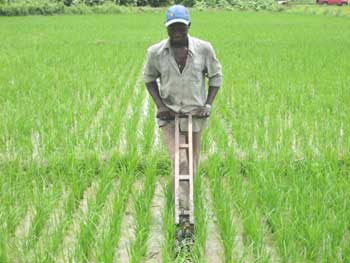
gathers to discuss the use of a sarclure rotative,
or rotary hoeing tool. This inexpensive device has been promoted
by farmers throughout Asia and is now gaining popularity in
Africa. It is one of the technologies that farmers in the
field schools are testing and modifying to better suit local
conditions. Consisting of a long handle and a metal body with
two circular rows rotating of teeth, farmers push the sarclure
between lines of transplanted rice much like a suburban American
might pilot a lawnmower. The farmers are enthusiastic about
the push weeder. Sawadogo noted that “it saves us hours
of work and it uses no chemicals at all.”
In the adjacent field, several small plots of rice are sectioned
off with long sticks driven into the ground like miniature
fence posts. “Those are the parcels set aside for experiments.
In that one we cut off leaves of rice plants to show farmers
that even if there are pests, the plant can withstand damage
without reduced yields.”
Inside the fence line, rows of rice stand adjacent to each
other, each with different proportions of leaves precisely
removed. “This amazes farmers, because they would normally
not think of or risk damaging their own plants. But here we
can experiment with these techniques.
Learning to live with a few bugs
“We have learned that we could cut about half the
leaves of a rice plant off during its vegetative stage without
losing a single grain at harvest because the plant compensates
and grows back,” Sawadogo explains. “That helps
farmers to realize that they don’t need to waste their
money on insecticides. Even when they have a few insects eating
their rice, their yield will be the same.”
Nearby, another parcel is roped off. Several of the bushy
rice plants inside are draped with mosquito netting, the bottom
of which is dug deep into the soil. “That is the insect
zoo,” says Sawadogo. “We encourage farmers to
catch insects in their fields and then we discuss which insect
might be a pest or a friend of the farmer. When there is disagreement
about the insects, we put them inside the mosquito netting
with a rice plant and keep them there.”
Inside the netting, several beetles and other kinds of bugs
crawled about. “In that zoo, one farmer thought the
beetles were pests and wanted to spray them in his field.”
Sawadogo continued “…but when we put the insects
inside he learned that it didn’t want to eat the rice.
Instead, the insect actually ate other insects!
“If I had just told him it was not a pest the farmer
would not have believed me,” Sawadogo claims. “But
now he knows to conserve the beetles because he learned by
experimenting with the insects and seeing the results himself.
“Who says that experiments are only for agronomists?”

|